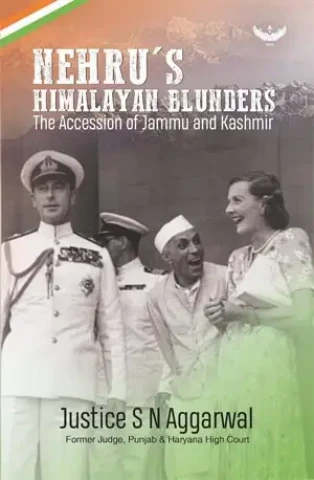
When Pakistan's tribal militias invaded Jammu and Kashmir in October 1947, the decisions taken in the following weeks determined the shape of the subcontinent's most intractable conflict. Jawaharlal Nehru made choices — military, diplomatic, and procedural — that resulted in a portion of J&K falling under Pakistani occupation. Justice S. N. Aggarwal spent years in the archives finding out exactly what those choices were and why Nehru made them.
The research draws on Lord Mountbatten's personal diaries and declassified archival documents to reconstruct the sequence of events around the accession: the tension between Nehru and Sardar Patel, Mountbatten's private assessments of both men, and the specific diplomatic errors that closed off options India might otherwise have kept open. The argument is not that the outcome was inevitable — it is that Nehru's particular combination of idealism, miscalculation, and personal compromise produced avoidable consequences that India still lives with.
For anyone who wants to understand how the Kashmir dispute actually began — what was decided, by whom, and what was traded away — this is the foundational account.
What did Mountbatten actually think of Nehru and Patel? Why did Nehru do such a poor job of defending India’s interests in J & K? How was Nehru compromised? Nehru’s Himalayan Blunders: The Accession of Jammu and Kashmir documents the major errors of Nehru, diplomatic and military, which led to India losing a portion of Jammu and Kashmir to Pakistan’s military occupation and to continued conflict between the two states. Justice S N Aggarwal’s painstaking research uncovers gems from archival documents including Lord Mountbatten’s personal diaries and documents the series of events around Jammu and Kashmir’s accession, including the conflict between Jawaharlal Nehru and Sardar Patel. An enduring view into what actually happened, and Nehru’s culpability, will leave you stunned.