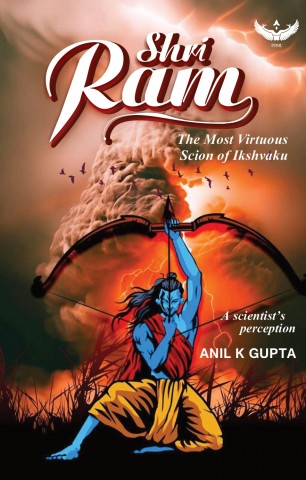

-:ABOUT THE AUTHOR:- Anil K Gupta had his schooling at Uttar Pradesh, completed graduation from AMU Aligarh and post-graduation from Banaras Hindu University Varanasi. In 1987, he joined as a Lecturer in the Department of Geology and Geophysics, Indian Institute of Technology Kharagpur, and has been Professor (HAG) since 2009 in the same Institute. His research interests encompass studies of paleoclimatic and paleoceanographic changes in the Indo-Pacific and Atlantic Oceans with special reference to linkages between Indian monsoon variability and human societies. He has widely worked on response of human societies and vegetation to monsoon shifts, as well as domestication of plants and animals during the past 10,000 years. His other research interests include decoding events mentioned in Ramayana and Mahabharata using geoscience based evidences. He has been on several International assignments. In 1990, he visited Louisiana State University at Baton Rouge, USA, for a year as PDF. In 1999, he was a Senior JSPS Fellow at Shimane University, Matsue, Japan, and in 2001, he visited as a senior NRC Research Scientist at National Oceanic and Atmospheric Administration, Boulder. From 2010 to 2017, Anil Gupta served as Director of the Wadia Institute of Himalayan Geology, Dehradun-A Ministry of Science and Technology Autonomous Institute. Anil Gupta has received numerous awards for his work including the UNESCO-TWAS Prize from the World Academy of Sciences in 2010. In 2012, he was granted the J.C. Bose Fellowship by the Department of Science and Technology. He is the recipient of National Mineral Award from the Ministry of Mines, Prof. T. M. Harris Medal by Birbal Sahni Institute of Paleobotany and Dr. J. Coggin Brown Memorial (Gold) Medal by the MGMI. Anil Gupta is the Fellow of all the Science Academies of India and also the Fellow of the World Academy of Sciences (FTWAS).
View Author Profile